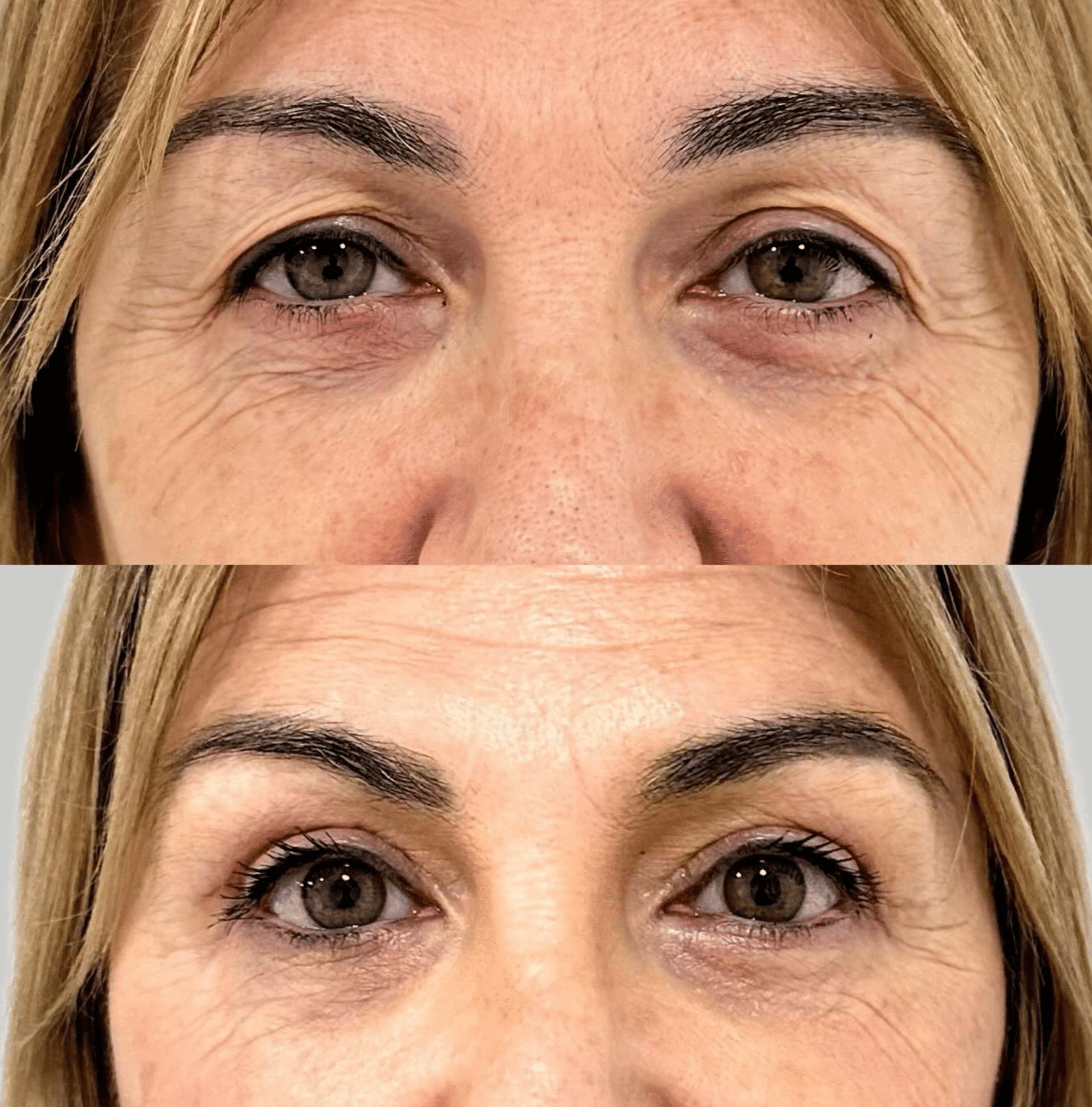
Blepharoplasty, or eyelid surgery, is one of the procedures with the highest satisfaction rates in the field of facial cosmetic surgery. And this is no coincidence: the eyes are the first point of visual contact between people, and when drooping eyelids or bags under the eyes give the impression of chronic tiredness that does not reflect how we really feel, the impact on self-esteem is considerable.
However, many patients come to my clinic with questions about
In this article I’m going to answer all those questions with the clarity you deserve before you make a decision.
Upper vs lower blepharoplasty: what each procedure corrects
Although they share the same name and target the same anatomical area, upper and lower blepharoplasty are procedures with different objectives, different target patient groups and recovery processes that differ in certain respects.
See Upper blepharoplasty: What it is, how it is performed and real results
See Lower blepharoplasty. What it is and how it is performed.
Upper blepharoplasty: removal of excess skin from the eyelid
Over time, the skin of the upper eyelid loses its elasticity and begins to droop, creating a fold of excess skin that can partially obstruct the field of vision and give the face a heavy, aged appearance. In advanced cases, it can even interfere with peripheral vision, making the procedure a functional necessity rather than merely a cosmetic one.
Upper blepharoplasty involves removing excess skin and, where present, excess fat from the upper eyelid region via a carefully placed incision in the natural crease of the eyelid, which makes the scar virtually invisible once it has healed.
It is the blepharoplasty most commonly requested and, in general, the one with the fastest recovery time. It is performed under local anaesthesia with gentle sedationtakes between 30 and 45 minutes in the operating theatre.
Typical candidates: People aged 35–40 and over who have drooping upper eyelids, a tired or heavy-looking appearance, eyelid asymmetry, or visual impairment caused by excess skin.
Lower blepharoplasty: removing eye bags and dark circles
Bags under the eyes have a different cause to drooping upper eyelids. They are caused by the protrusion of orbital fat (the fat pad that protects the eyeball) through a septum that weakens over time, resulting in that characteristic bulge beneath the eye.
Lower blepharoplasty addresses this problem by removing or redistributing the protruding fat and, where there is excess skin, removing that as well. There are two main approaches:
- Transcutaneous approach (external): The incision is made just below the lash line, allowing both the fat and the excess skin to be addressed. This is the recommended approach when there is significant excess skin.
- Transconjunctival approach (internal): The incision is made in the conjunctiva, on the inside of the eyelid, leaving no visible external scar. This is the preferred approach when bags under the eyes are the main problem and there is sufficient skin quality and quantity, particularly in younger patients.
Candidatos típicos: Personas con bolsas bajo los ojos persistentes (que no mejoran con descanso ni tratamientos tópicos), ojeras de componente estructural, aspecto de cansancio crónico independientemente de la edad.
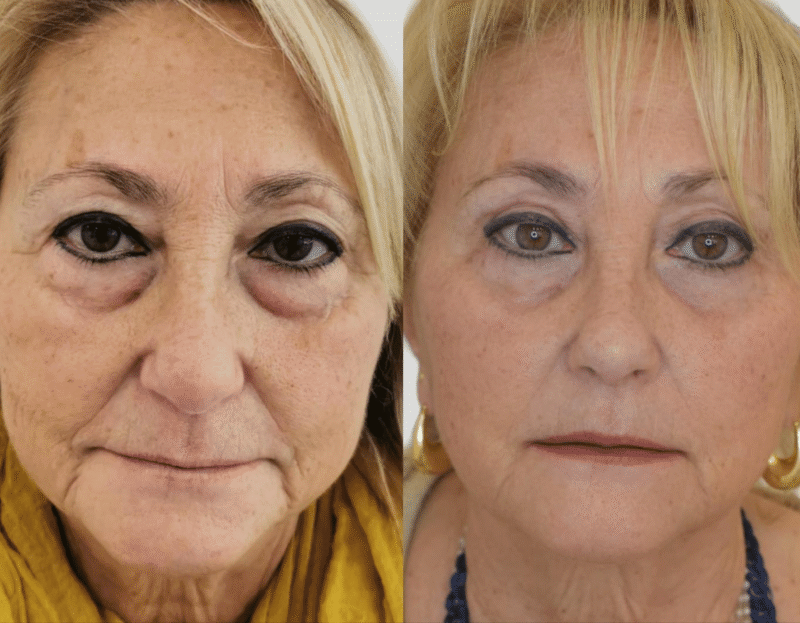
Blepharoplasty (full). Before and after
When is it recommended to have both procedures done at the same time (full blepharoplasty)?
This is one of the questions I’m asked most often in my practice, and the answer depends on an individual assessment of each patient.
Performing upper and lower blepharoplasty during the same surgical session—what we refer to as complete blepharoplasty—is perfectly safe when there is a clinical indication for both areas. In fact, it offers real advantages over performing them separately:
Advantages of doing them in the same session:
- A single procedure, a single anaesthetic, a single recovery period
- Duration in the operating theatre of a full blepharoplasty: between 90 and 120 minutes under local anaesthesia with sedation.
- The result is more harmonious because both eyelids are treated at the same time
- More cost-effective (shared fees, operating theatre and anaesthesia)
- Fewer sick leave cases in the overall total
When is it best to do them separately?
In some cases, the surgeon may recommend performing them in separate sessions: when combining the two procedures would extend the duration of the operation to a point where the anaesthetic risk increases; when the patient prefers to assess the results of one procedure before deciding on the other; or when the complexity of the lower blepharoplasty requires a more elaborate technique that is best performed on its own.
Generally speaking, if the patient has issues with both eyelids and is in good general health, full blepharoplasty performed in a single session is the most common procedure at our clinic.
Eyelid surgery, step by step: what happens in the operating theatre
Understanding what is going to happen during the surgery significantly reduces pre-operative anxiety which usually accompanies any surgery. Here I explain in a clear way how we perform a blepharoplasty at our cosmetic clinic in Barcelona.
- Before we begin: Intravenous sedation is administered, inducing a state of deep relaxation. Local anaesthetic is then applied to the eyelid area. At this stage, the patient is calm and feels no pain. The local anaesthetic is sufficient to ensure that the procedure is completely pain-free.
- During the operation: The surgeon carefully marks out the incision lines, following the natural creases of the eyelid. Excess skin is removed and fat is treated where necessary. The sutures are extremely fine and designed to leave a barely visible scar.
- Once finished: The patient remains in the clinic for 1 to 2 hours under observation. Fine dressings are applied to the eyelids. The patient may go home accompanied on the same day.
Guide to recovery day by day
This is probably the section patients are most interested in before deciding to undergo blepharoplasty or any other cosmetic procedure. In my experience, this is what you can expect at each stage of the post-operative recovery following lower, upper or full eyelid surgery
Day 0 — The day of the operation
When you get home, your eyelids will most likely feel numb due to the local anaesthetic. Once this wears off, between 2 and 4 hours after the operation, you may experience a feeling of tightness, discomfort or mild pain, which can be easily managed with the prescribed painkillers. Swelling will begin to appear within the first few hours.
Key points for that day:
- Resting with your head raised (using an extra pillow)
- Apply a cold compress intermittently (never directly onto the skin)
- Do not rub your eyes under any circumstances
- Avoid reading, looking at screens or straining your eyes
Days 1–2 — The peak of inflammation
The swelling peaks between 24 and 48 hours. It is completely normal for the eyelids to be swollen, for bruising to appear, and for the eyes to be partially closed due to the swelling. This can be alarming if you are not expecting it, but it is the tissue’s normal response to surgery.
Your eyes may feel watery, dry, sensitive to light or gritty. These symptoms are common and can be relieved with artificial tears and the prescribed eye ointment. Any pain that does occur can be easily managed with oral painkillers.
During these days: rest at home, avoid strenuous physical activity, do not lean forward, do not perform Valsalva manoeuvres (straining when defecating, sneezing forcefully).
Days 3–5 — The swelling begins to subside
From the third day onwards, the swelling begins to subside noticeably. Any bruises that have appeared change colour (from purple to yellowish-green), which indicates that they are being reabsorbed. Many patients begin to see an improvement in their overall appearance, which is very encouraging.
The feeling of tension in the eyelids is normal during this phase. The skin is adjusting to its new position. Some patients report difficulty in closing their eyes completely a20> their eyes when going to sleep during the first few days, something that will gradually return to normal.
Days 5–7 — Withdrawal of points
The stitches are removed during a clinic appointment between the fifth and seventh day. It is a quick and painless procedure. Once the stitches have been removed, the appearance improves significantly as the most visible sign of the surgery disappears. At this stage, the scar is pink and slightly visible, but it can already be concealed with concealer under medical supervision.
Week 2 — Gradual return to work
Most patients can return to office work by the second week, especially if they wear glasses to help conceal any remaining swelling or bruising. You’ll look well-rested, and anyone who doesn’t know you’ve had surgery probably won’t notice.
Things to avoid even at this stage: physical exercise, direct exposure to the sun, make-up not approved by the surgeon, swimming, saunas or any activity involving intense heat or humidity.
Weeks 3–4 — Normalisation
The residual swelling continues to subside gradually, although some people notice that the swelling is slightly more noticeable in the mornings when they wake up. This is normal and will fade as the weeks go by. The scar continues to heal and become less noticeable.
During this phase, you can resume moderate physical exercise and your usual make-up. Swimming and those sports involving contact can wait until the following month.
Months 1–3 — The result begins to take hold
One month after blepharoplasty, the results are virtually permanent as far as one’s social circle is concerned. The improvement in the eyes is clearly visible: the eyes appear more open, and the overall appearance is more rested and rejuvenated, with no sign of having recently undergone surgery. At this stage, most patients regret not having had the operation sooner.
The scar will continue to heal: between the second and sixth month, it will gradually lose its pinkish hue until it becomes virtually invisible, particularly in the natural skin folds where the incision was made.
Months 3–6 — The final result
The result of blepharoplasty is achieved between a8> is achieved between 3 and 6 months. At this stage, the scars have healed completely, the skin has blended in naturally and the effect of rejuvenation shows all its dimension.
The scars from upper blepharoplasty are hidden in the natural crease of the eyelid. The scars from lower blepharoplasty transcutaneous, just below the line of the eyelashes. In both cases, with proper healing, they are practically invisible at a normal social distance.
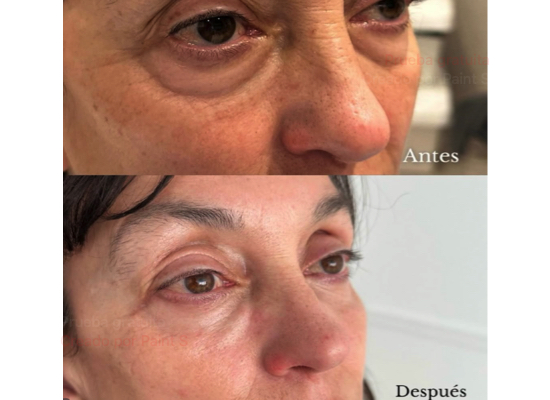
Patient who underwent lower blepharoplasty. 2 months later
Warning signs to watch out for during your recovery
Blepharoplasty is a surgery very safe when it is performed by a surgeon with specific experience in eyelids. However, as with any surgical procedure, it is important to be aware of the signs that should prompt contact immediately with the clinic:
- Severe pain that does not subside with the painkillers prescribed
- Active bleeding or a bruise that is growing rapidly
- Fever of over 38 °C in the first few days
- Loss of vision or significant impairment of vision
- Inability to close the eye completely (lagophthalmos) that persists beyond the first few days
- Signs of infection: redness worsening, heat, discharge with pus
In any of these situations, contact the clinic immediately or go to A&E if it is not possible to contact directly your surgeon.
Common myths about blepharoplasty
As with almost all cosmetic procedures, there are myths and misconceptions circulating, often based on specific cases that are generalised without any real basis. Here are some of those myths and what my experience with hundreds of patients has shown me
- Myth 1: “Blepharoplasty causes a lot of pain” False. It is one of the surgeries with the lowest level of post-operative pain. The majority of the patients describe discomfort and tension, not pain. Standard analgesics are sufficient to manage it.
- Myth 2: “The results last very shortly” False. The results of a10> an upper blepharoplasty properly performed last between 10 and 15 years. Lower blepharoplasty for bags has results that are practically permanent in the majority of the cases, since the fat removed does not return to appear.
- Myth 3: “It’s just a cosmetic operation, it’s not necessary” Not always. When the excess of skin on the upper eyelid interferes with the field of vision, blepharoplasty is indicated for functional reasons and, in some cases, may be covered partially by the public health < a29> or private under that diagnosis.
- Myth 4: “After having surgery on the eyes they feel strange for a long time” There is an adjustment period, it is clear, but it is brief. Visual discomfort (dryness, watery eyes, a sensation of grit) is common in the first weeks and usually disappear once the area heals completely.
- Myth 5: “Blepharoplasty also removes dark circles under the eyes” Partially true. Lower blepharoplasty improves bags under the eyes and can improve the appearance of dark circles, but the pigmentation component of dark circles (the dark skin tone) has a different origin—vascular or pigmentary—which cannot be corrected by surgery. In such cases, complementary treatments such as fillers in the nasolabial fold can enhance the surgical result.
Frequently Asked Questions FAQ
From what age is blepharoplasty recommended?
There is no universal minimum age. The decision is based on the condition of the tissues, not on chronological age. There are 35-year-olds with significant genetic ptosis, and 55-year-olds with eyelids in good condition. An individual assessment during a consultation is the only valid criterion.
Does blepharoplasty leave visible scars?
The incisions are made along the natural creases of the eyelid, meaning that the scars are virtually invisible once they have healed. In transconjunctival blepharoplasty (performed through the lower eyelid), there are no visible external scars.
Can I wear contact lenses after a blepharoplasty?
It is recommended that you do not wear contact lenses during the first 2–3 weeks following the surgery. Afterwards, you may resume gradually in accordance with the instructions of the surgeon and the progress of the healing process.
How many times can one have a blepharoplasty?
Most patients only need one blepharoplasty in their lifetime. In some cases, after many years, a revision of the upper eyelid may be necessary if the ageing process has once again caused excess skin to form. Lower blepharoplasty for bags under the eyes, by removing orbital fat, produces virtually permanent results in this specific area.
Can blepharoplasty be combined with other treatments?
Yes. Blepharoplasty is often combined with a facelift, canthopexy (repositioning of the outer corner of the eye), lipofilling (filling with the patient’s own fat to address the volume loss associated with under-eye hollows) or botulinum toxin for the glabella. This combined approach allows for a more comprehensive and harmonious facial rejuvenation result.
How much does blepharoplasty cost at Pedralbes Clinic?
The price of blepharoplasty in Barcelona includes the pre-operative consultation, pre-surgical tests, pre-surgical tests, the use of operating theatre, local anaesthesia with sedation, fees doctors’ and all the check-ups post-operative up to discharge. The quote is tailored depending on whether it involves involves an upper blepharoplasty, lower or complete blepharoplasty, and whether you require any type of complementary technique (canthopexy, cantoplasty, eyebrow lift, lipofilling, etc.). We offer options for financing. To get your exact quote, call us on 622 665 559 or send this form to request an assessment of your case.
You can also read:
11 frequently asked questions from patients about blepharoplasty
Cuánto tiempo tardaré en recuperarme de una blefaroplastia

Ha intervenido con éxito a cientos de pacientes que han confiado en sus manos y conocimientos para solucionar todo tipo de problemas estéticos en su rostro.
El dr. San Miguel es uno de los mejores cirujanos de rinoplastia y blefaroplastia en Barcelona y sus pacientes destacan la naturalidad de los resultados que consigue.