Rinoplastia de reducción de giba nasal
One of the parts most important of the face is the nose, which due to the fact that it is situated in the centre of the face. It takes on a great importance from an aesthetic point of view, since it is constantly visible.
Una gran parte de las personas de ascendencia europea presentan una nariz que se caracteriza por tener un dorso proyectado (también llamado giba). Más concretamente, la nariz mediterránea. Además de presentar un dorso proyectado, suele tener una punta algo caída y tener unos cartílagos alares de excesivo tamaño (los cartílagos alares dan la forma a la punta nasal).


It is essential to carry out a computer simulation
To determine how much of the hump needs to be removed, it is essential to carry out a computer simulation of the desired outcome. This allows the image to be overlaid onto that of the nose prior to surgery. This allows us to determine the order of magnitude of the hump to be removed, the amount of rotation required at the tip and/or the amount of projection reduction to be carried out (if necessary). A frontal simulation can help give an idea of the final result, but it is less predictable, so it is usually used to simulate cases where the nose is crooked.
Rhinoplasty for reduction of the nasal hump
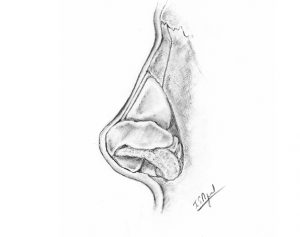
It is usually performed via an incision that is hidden inside the nose (closed rhinoplasty). This means that no visible scar is left after the operation. Once the hump has been removed, the nasal base (the bones on either side of the septum) is usually reshaped to achieve the correct shape at the very top of the nose and prevent an ‘open roof’ deformity.
Although the removal of the hump may seem the part that is easiest of a rhinoplasty, it is the one that requires the most precision and meticulousness. This is to prevent collapse of the cartilages quadrangular (cartilages which lie on either and both sides of the middle part of a33> the nose; if they collapse, the nose may appear crooked).
The alar cartilages are preserved correctly using the Split Hump technique, described by the Dutch surgeon J. Lohuis in 2012. Once we have successfully shaped the upper and middle parts of the nose, we move on to the tip. A comprehensive description of the techniques that can be used to manage the nasal tip can be found in the chapter ‘Management of the nasal tip’.
It is not just a matter of tapering the tip, but of ensuring it looks natural, avoiding excessive angularity, and ensuring it rotates and projects correctly.



Frequently asked questions about rhinoplasty for hump reduction

Book your reduction rhinoplasty in Barcelona now
Other treatments
for rhinoplasty
Clínica de cirugía plástica en Barcelona
Pedralbes Clinic es una de las mejores clínicas de cirugía maxilofacial en Barcelona. Dispone de unas instalaciones de vanguardia y un experimentado equipo médico estético.
Tanto la intervención como el tratamiento pre y postoperatorio serán realizados en las propias instalaciones de la clínica situada en el Paseo de Manuel Girona, 14, en Barcelona.
Otros tratamientos de cirugía estética: