Cosmetic surgery for men has grown steadily in Spain over the last decade, and rhinoplasty is one of the procedures that has seen the greatest increase among male patients. However, there remains a lack of information specifically aimed at men: most of the content available online discusses rhinoplasty in general terms or uses examples and references clearly geared towards women.
This has real consequences in the clinic. Many men arrive with expectations based on results seen in women (smaller noses, more refined tips, softer profiles) that do not necessarily correspond to what is aesthetically appropriate for a male face.
When the surgeon applies the same criteria without taking into account gender, the result may be technically flawless but visually incorrect: a nose that does not fit with the face of the patient.
At Pedralbes Clinic, rhinoplasty male we plan using criteria anatomical and aesthetic specific to men. In this article I explain what those criteria are, what you should expect from the procedure on the nose and how to identify whether your surgeon is applying them correctly.
Why is male rhinoplasty different from female rhinoplasty: the anatomical criteria
The aim of any rhinoplasty is to achieve a nose that is in harmony with the rest of the face. The problem is that what is harmonious in a woman’s face is not necessarily so in a man’s, because the proportions, bone structure and facial angles are fundamentally different.
The nasolabial angle
The nasolabial angle is the angle formed between the columella (the lower part of the nose, between the nostrils) and the upper lip. In classical female aesthetics, this angle ranges between 100 and 115 degrees, resulting in a nose with a tip that is slightly upturned and a more delicate appearance. In men, the ideal angle is between 90 and 95 degrees: the tip of the nose should be horizontal or even slightly pointing downwards.
A male nose with an nasolabial angle that is excessively wide appears visually incongruous with the proportions of the face.
The projection and thickness of the spine
Men tend to have thicker, oilier skin than women in the nasal area, particularly on the tip of the nose. This has two significant implications: healing may be slower in that area, and there are stricter technical limitations when it comes to reducing the size of the nasal tip, as the thickness of the skin determines how much the underlying structure can be refined without the result looking unnatural.
Furthermore, a man’s nasal bridge allows for, and even enhances, a more pronounced projection. What might be perceived as a bump requiring correction in a woman can, in a man, be a feature that lends character and masculinity to the profile. Not every nose with a prominent bridge needs to be corrected.
The width of the nasal base
The nasal bases are proportionally wider in men. The classic rule that the width of the nose should match the distance between the inner corners of the eyes applies differently in men, where a slightly wider base fits correctly within the context of a face with greater cheekbone and jaw width.
The projection of the tip
In men, a strongly projecting or excessively refined nasal tip can appear out of keeping with the overall robustness of the face. When planning the tip during a male rhinoplasty, the aim is usually to achieve moderate projection: well-defined but without the level of detail that characterises many female rhinoplasties, which often produce a highly stylised result.
See Rhinoplasty for Men: How to improve your nose without losing your masculinity
The most significant technical differences regarding the female nose
Beyond aesthetic considerations, there are specific technical differences in how surgery is approached in men:
Greater strength of bone and cartilage.
The male nasal skeleton is generally more robust. This may require greater precision in osteotomies (cuts in the nasal bone) and more careful planning when working on the bony dorsum. Ultrasonic rhinoplasty—which uses ultrasound to work on the bone with greater precision and less trauma—is particularly well-suited to these cases.
Skin thicker thickness.
This factor directly influences expectations: a man with very thick skin around the tip of the nose must realise that there are limits to what can be achieved. Promising results that the skin cannot support is one of the most common causes of post-operative dissatisfaction.
Lower tolerance for over-operation.
A nose that is excessively small or has a tip that is too refined on a man’s face creates a much more striking contrast than on a woman’s. The guiding principle should always be the overall harmony of the face, not the isolated perfection of the nose.
The importance of the projection of the mentonian.
In many cases, what the patient perceives as a problem with their nose is actually an issue of facial proportion linked to a receding chin. A jaw that lacks sufficient projection makes the nose appear larger than it actually is. Before planning rhinoplasty, it is essential to consider whether a mentoplasty could improve the overall result with less invasive nasal surgery.
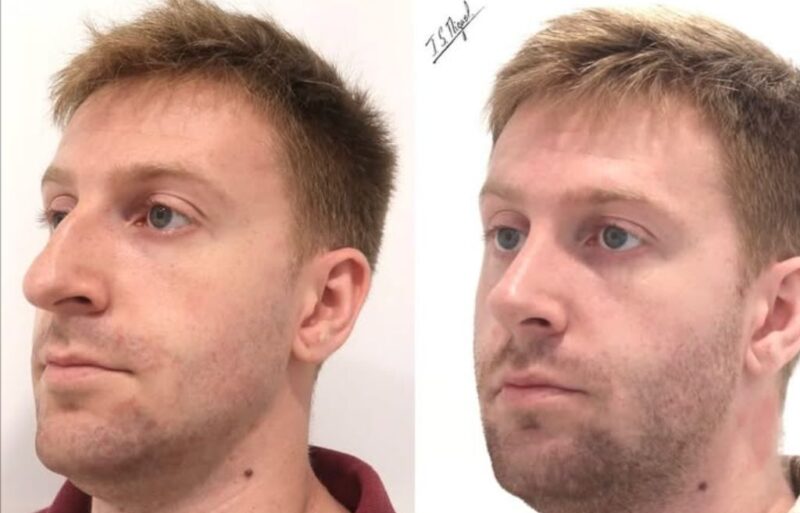
Patient who has undergone a rhinoseptoplasty using ultrasound
The procedures most commonly requested by men
1. Correction of a nasal hump
Dorsal reduction is the most common procedure among men undergoing rhinoplasty. Unlike female rhinoplasty, where the aim is usually to achieve a completely smooth profile, in men the goal is often a slightly straight profile or one with a minimal curve that preserves the character of the face. Deciding how much to reduce the hump is one of the most delicate aspects of male rhinoplasty and requires careful photographic planning.
2. Correction of a deviated nasal septum (rhinoseptoplasty)
Many men seek treatment for a crooked or asymmetrical nose, which often combines aesthetic concerns with genuine breathing difficulties. Rhinoseptoplasty—which simultaneously corrects the septum and improves the appearance of the nose—is a very common procedure with a high satisfaction rate, as it resolves two problems in a single operation.
See Rhinoseptoplasty
3. Refinement of the tip of the nose
A bulbous—or rounded, undefined—nose tip is a common concern that requires a specific approach in men: the aim is to add definition without making the nose appear feminine. Work on the alar cartilages to improve the projection and definition of the tip must be carried out with a clear distinction from female standards.
4. Correction of wide nostrils (alarplasty)
Alar base reduction is a relatively minor surgical procedure that has a significant visual impact. It is performed via incisions in the alar sulcus that are virtually invisible, and can be carried out on its own or as part of a more extensive rhinoplasty.
See Nasal alar reduction vs. alarplasty: differences between these surgeries to reduce the nostrils
Rinoplastia masculina y funcionalidad: cuando el problema es respirar
A significant proportion of men who consult for rhinoplasty also have or, or basically, a functional problem: difficulty in breathing through the nose, snoring, apnoea during sleep or a sensation of chronic nasal obstruction. In many cases, this problem originates from origin in a deviation of the nasal septum, a hypertrophy of the turbinates or a combination of both.
When there is a functional component, the procedure is known as rhinoseptoplasty and combines the correction of the septum with the improvement of the external profile. The advantages of addressing them in the same procedure are clear: a single anaesthetic, a single recovery and a outcome that improves both function and aesthetics.
From a practical point of view, when surgery has a confirmed functional indication, part of the cost may be be covered by the health insurance or private medical insurance, which significantly changes the economic analysis of the procedure. During the pre-operative consultation, we always assess both aspects and advise the patient on which part of the procedure may be covered.

Patient who underwent a rhinoseptoplasty using ultrasound and turbinoplasty using radiofrequency
Recovery after rhinoplasty: what to expect and how to manage it alongside work
The recovery from a male rhinoplasty follows the same general stages as any rhinoplasty, but there are specific features that are relevant to the typical profile of the male patient.
The first week: the most noticeable
Immediately after surgery, a rigid nasal splint is fitted to protect the structure whilst healing begins. Swelling and bruising under the eyes are common during the first few days, particularly if osteotomies have been performed on the bridge of the nose. Most patients describe this phase as uncomfortable rather than painful, and the discomfort is easily managed with the prescribed medication.
The removal of the splint takes place between the 7th and 10th day. This is the first time when the patient can see an a16> result approximate, although the nose will be still swollen.
The second week: return to work
The majority of the patients who work in an office can return to work during the second week. For jobs involving physical exertion or activities involving contact, the period lasts between 3 and 4 weeks.
If your work requires you to wear glasses that rest on the bridge of your nose, you should not wear them for the first 6–8 weeks after surgery so as not to interfere with the healing of the bridge. This is a detail that many patients do not consider, and it is advisable to plan ahead.
Sport and activities involving physical contact
Light cardiovascular exercise can be resumed after 3–4 weeks. Contact sports such as football, martial arts, basketball, etc. should be avoided for at least 3 months. A blow to the nose during the healing phase can irreversibly affect the surgical outcome.
The final result
The swelling gradually subsides during the first month, butthe final result is not assessed until 12 months have passed, by which time the deeper residual swelling has completely disappeared. Men with thicker skin on the tip may find that this area takes slightly longer to settle than the back of the penis.
How to choose the right surgeon
Rhinoplasty is one of the cosmetic surgeries with the steepest learning curve. The results depend on the surgeon’s specific experience and, in the case of male patients, on their distinctive aesthetic judgement. These are the questions you should ask during your consultation:
How many rhinoplasties do you perform each year and what percentage of these are on men?
A surgeon with real-world experience in male rhinoplasty has specific criteria. If there are no male cases in his gallery of results, that says something.
Could you show me cases of patients with similar characteristics?
No generic results: cases with the same type of nose, the same type of skin and the same goal as yours.
What treatment do you recommend for my condition, and why?
A good surgeon explains the logic behind the technique he proposes: why he chooses an open or closed approach, whether he will use ultrasonic rhinoplasty, if there is a functional component. Be wary of anyone who suggests always the same technique without an individualised assessment.
What is the outcome that should not be expected in my case?
An surgeon who is honest sets boundaries for what surgery can achieve. If during the consultation everything seems possible without any caveats, it is a sign of alarm.
Is the simulation of results included?
The photographic simulation —which shows an approximate result in a side-view photo — allows expectations to be aligned before the operation. Not all the surgeons offer it, but when it is available it significantly improves post-operative satisfaction.
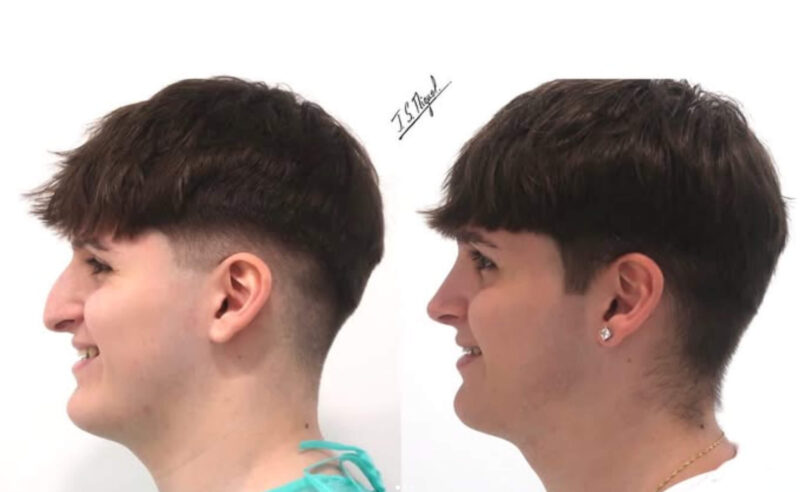
Rhinoseptoplasty using ultrasound and preservation of ligaments. 2 months later
Frequently asked questions about rhinoplasty in men
At what age is it recommended to have a nose job?
The main requirement is that facial development must be complete, which usually occurs between the ages of 17 and 18 in boys. There is no upper age limit: rhinoplasty can be performed on adults of any age provided they are in good general health.
Is recovery different in men than in women?
Not in any significant way. Men’s skin, which is thicker than women’s, can slow down slightly the reduction of swelling in the area of the tip of the nose, but the process of recovery is similar in duration and in the sequence of phases.
Does male rhinoplasty leave visible scars?
In the closed technique, the incisions are made entirely within the nostrils, leaving no external scar. In the open technique, a small incision is made in the columella which, if healed properly, is virtually imperceptible at a normal social distance. The choice of technique depends on the individual case.
What is the price of a rhinoplasty for men at Pedralbes Clinic?
The price varies depending on the complexity of the procedure: whether it is a primary or secondary rhinoplasty, whether it involves a functional component, and whether it requires ultrasonic rhinoplasty. During the consultation, we carry out a personalised assessment and provide a detailed quote covering all costs—anaesthesia, operating theatre fees, surgeon’s fees and post-operative check-ups—as well as financing options.
Can I combine rhinoplasty with other surgeries in the same session?
Yes. The most common combination for men is rhinoseptoplasty (nose and septum) in a single procedure. It is also possible to combine this with a mentoplasty when facial analysis reveals that a receding chin contributes to the visual imbalance that the patient perceives in their nose. These combinations are carefully planned so as not to exceed safe surgical time limits.
Male rhinoplasty is a procedure that is technically demanding and requires aesthetic criteria that differ from those of female rhinoplasty. The aim is not a nose that is smaller or more refined: it is a nose that fits with the structure and proportions of the face of the patient, which respects the masculine identity of the result and which, when there is a functional component, it also improves respiratory capacity.
If you are considering having surgery on your nose, the first step is to call us on 622 665 559 and book a consultation where we can assess your case in detail: facial structure, type of skin, goals and realistic expectations for achieving a harmonious nose, masculine and 100% functional just as we have already achieved for hundreds of a35> men who just like you, decided to undergo a nose job to feel more a44> comfortable and confident with their face and/or improve their breathing.
You can also read:
Rhinoplasty and ageing: What happens to a nose that has undergone surgery as time goes by
Post-operative care following rhinoplasty: How to ensure a smooth recovery
Rhinoplasty ultrasonic vs traditional. Key differences. Which is better
Rinoplastia abierta o cerrada: Cuál es la mejor técnica para tu nariz
Are you unable to breathe properly through your nose? Turbinoplasty offers a solution

Ha intervenido con éxito a cientos de pacientes que han confiado en sus manos y conocimientos para solucionar todo tipo de problemas estéticos en su rostro.
El dr. San Miguel es uno de los mejores cirujanos de rinoplastia y blefaroplastia en Barcelona y sus pacientes destacan la naturalidad de los resultados que consigue.