One of the questions I most often hear in consultation is: “Doctor, do I need a full facelift or is a mini-facelift enough?” And the answer honest answer is that it depends on two specific factors: how much tissue has lost its position and what are the realistic expectations of the patient.
There is no universal answer. But there is a clear clinical criterion to guide that decision, and in this article, a11> that decision, and in this article I’m going to explain it to you in detail, without euphemisms and without selling you what you don’t need.
What is exactly each technique
Mini-facelift
The mini-lift, also known as S-lift or short incision facelift, is a procedure in cosmetic surgery that is minimally invasive a12> minimally invasive procedure that takes effect on the lower third of the face: the jaw, the double chin in its early stages and the cheeks that have sagged. It is performed via a series of small incisions located in front of the the ear and, in some cases, behind the lobe, so that the scar is practically invisible once it has healed.
The aim is to reposition the tissues that have begun to sag, restoring a jawline that is more defined and a overall more relaxed appearance. It is not a radical solution: it is a technique for early maintenance, recommended when the signs of ageing are moderate and the tissues still retain good elastic quality.
It is carried out under local anaesthesia with sedation, which eliminates the risks associated with to general anaesthesia and significantly reduces the time needed for recovery. The procedure lasts between 90 minutes and 2 hours in the operating theatre.
The facelift
The full facelift , with its most advanced variant, the cervico-facial lift, is a procedure more extensive than which acts on multiple layers of the face and the neck. It works not only on the skin, but also on the muscle platysma (the muscle on the surface of the neck) and the layer SMAS (superficial musculoaponeurotic system), which is the deep structure that supports the facial tissues.
The incisions are longer: run from the temple, pass in front of the ear and extend a11> extend along behind it to the nape of the neck. In return, the results are more comprehensive, more long-lasting and allow correct changes more advanced signs of ageing: pronounced facial ptosis, double chin well-established, loss of jawline definition severe and neck laxity.
It is usually performed under general anaesthesia and takes between 3 and 5 hours in the operating theatre.
The key differences between a facelift and a mini-facelift
The following table summarises the key factors to consider when making an informed decision:
|
Feature |
Mini-lifting |
Neck and face lift |
|
Area of action |
Lower third of the face |
Face full + neck |
|
Plans treaties |
Skin and superficial SMAS |
Skin, SMAS deep, platysma |
|
Anaesthesia |
Local + sedation |
General |
|
Duration in the operating theatre |
90–120 minutes |
3–5 hours |
|
Recovery visible |
10–14 days |
3–4 weeks |
|
Return to work work |
7–10 days |
14–21 days |
|
Duration of results |
5–7 years |
10–15 years |
|
Scar |
Minimal, periauricular |
Periauricular extended |
|
Ideal for |
Early to moderate ageing |
Moderate to advanced ageing |
What is recommended at each stage for different age groups
Ages 35 to 45: smart prevention
In this section, the changes associated with ageing of the face tend to be subtle: a jawline that begins to lose definition, the first nasolabial folds nasolabial, a slight loss of volume in the cheeks. In many cases, surgery is still not the first option.
Non-surgical treatments—such as biostimulators, fillers, radiofrequency, etc.—can maintain a natural-looking result for years. However, when there is actual tissue ptosis (i.e. the tissue has sagged), no surface treatment can reverse it. In such cases, a mini-facelift is the procedure of choice: it acts quickly, is minimally invasive and delays the natural ageing process by almost a decade.
The key at this age: not to wait for the changes to a7> become so obvious that they require major surgery. Intervening early means less invasiveness, less recovery time and results that are more natural-looking.
Aged between 45 and 55: the most common age group
This is the age group for which I receive the most enquiries about facelifts. Patients notice changes that no longer respond to non-surgical treatments: a double chin is visible, the jawline has lost its definition, the nasolabial folds are more pronounced, and the neck is beginning to show signs of sagging.
At this stage, the decision between a mini-facelift and a full facelift depends on the degree of sagging. If the sagging is mainly in the lower third and the tissues are still of reasonable quality, a mini-facelift can produce excellent results. If the neck is significantly affected or the sagging extends to the middle third, a cervico-facial facelift offers a more comprehensive and longer-lasting correction.
In this range, the pre-operative consultation is particularly important to ensure that the condition is neither under-treated nor over-treated.
From the age of 55: comprehensive and long-lasting results
As time goes by, the changes accumulated in multiple areas of the face and the neck mean so that the mini-facelift proves insufficient to provide a satisfactory result. From the age of 55 onwards, and depending on the condition of the skin, a neck and face lift is often the most appropriate option.
This technique allows work to be carried out in depth, repositioning the SMAS and the platysma, and deliver results that last for 10 to 15 years. Recovery takes longer, yes, but the result is more complete and more stable over time.
Important: chronological age is merely a reference point. There are patients aged 52 years with significant tissue laxity who require a full facelift, and patients aged 60 years with tissues in excellent condition who respond very well to a mini-facelift. The criterion is always determined by an individualised assessment during a consultation, not by age.
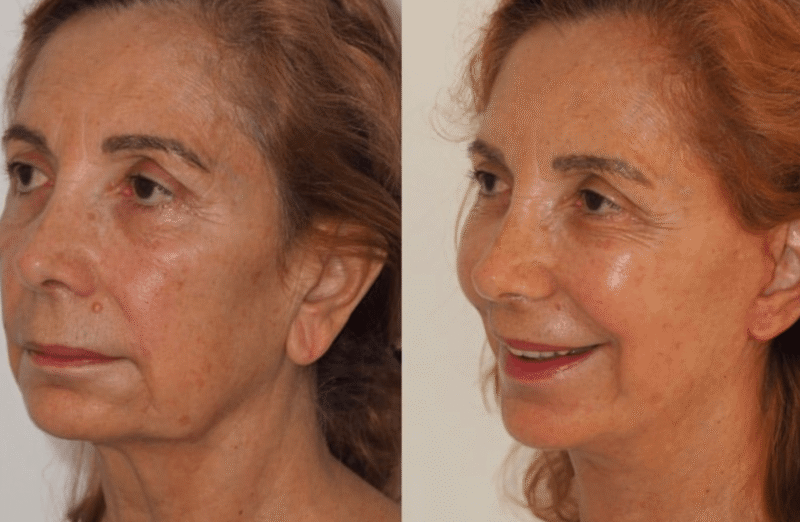
Patient who underwent a deep plane facelift with platysmaplasty performed by Dr Mis. 3 months after surgery
Signs that it is no longer enough to have just a mini-facelift
If you identify any of the following signs in your assessment, a referral for a full facial lift -facial full will likely provide a result that is more satisfactory:
- Double chin that has set in which does not respond to liposuction of the double chin alone
- Cervical laxity with bands of the platysma visible
- A very pronounced nasolabial fold with a loss of volume in the middle third
- Ptosis of the middle third (sagging cheeks, drooping cheeks, cheekbones barely visible)
- Advanced ageing with loss of elastic quality significant of the skin
- Previous mini-facelift procedure whose results have now worn off
In all these cases, the mini-facelift may prove insufficient and lead to a disappointment which, in fact, is the result of an incorrect indication, not due to a deficient technique.
Recovery: how long it will take in each case
One of the factors that most influence the decision to the patients is the length of leave. This is what you can expect, normally, in each case.
Recovery from a mini-facelift
- Days 1–3: Moderate swelling and some tension in the area. The majority of the patients describe discomfort rather than pain, perfectly manageable with oral analgesics. Light dressings are worn and one should avoid physical exertion.
- Days 4–7: The swelling begins to subside. Any bruising that does occur is usually minor and localised. Stitches are removed between the 5th and 7th day. Many patients can lead a quiet life at home without it being obvious that they have had surgery.
- Days 7–14: The vast majority of patients return to office work during this phase. Make-up may be worn from day 10–12 to conceal any remaining swelling. The overall appearance is that of a well-rested person, not someone who has recently had surgery.
- Months 1–3: The result continues to improve. The skin finishes adapting, the scar matures and the effect of a13> rejuvenation becomes more and more natural.
Recovery from a neck and face lift
Days 1–5: More swelling and slightly more discomfort than with a mini-facelift, especially in the area of the neck. Compression dressings are applied and the keep the head raised to promote drainage.
Week 2: The swelling is significantly reduced. The bruising, which is common during the first few days, begins to fade. The stitches are gradually removed.
Weeks 3–4: The majority of patients can return to their work. The condition continues to improve gradually. Some areas may retain a slight stiffness or temporary numbness which will disappear.
Months 2–6: Period of maturation of the result. The scar finishes of fading, the skin becomes integrated naturally and the effect of rejuvenation reveals all its full potential.
How long do the results last?
This is perhaps the most relevant factor when it comes to deciding a6> assessing which intervention to choose, especially when one is also considering the financial aspect.
A mini-facelift offers results that last between 5 and 7 years, although this varies depending on skin quality, the patient’s lifestyle (sun protection, smoking, hydration), maintenance with non-surgical treatments, and genetic predisposition to ageing.
The cervico-facial facelift, by acting on deeper and more extensive areas, offers results that usually last for between 10 and 15 years. It is a long-term investment which, in many cases, represents the only procedure of this kind in the life of the patient.
An important point that is sometimes overlooked: No facelift ‘stops’ the ageing process. The process continues, and the tissues will continue to age after the procedure. What surgery does is reset the clock to a younger state, and from there, ageing continues naturally. That is why maintaining a healthy lifestyle and good skincare significantly prolongs the duration of the results.
Frequently Asked Questions FAQ
Can I have a mini-facelift if I had a full facelift several years ago?
Yes, it is possible, depending on the time that has elapsed and the current condition of the tissues. Following a full facelift, a mini-facelift can be useful as a maintenance procedure, targeting areas where signs of ageing have reappeared. The pre-operative assessment will determine whether this is the most appropriate course of action or whether a more specific touch-up is recommended.
Can a facelift be combined with other surgical procedures?
Yes. It is common to combine a mini-facelift or cervico-facial lift with blepharoplasty (eyelid surgery) or double chin liposuction to achieve a more comprehensive facial rejuvenation. The combination of procedures must be carefully planned so as not to unduly prolong the surgical time or unnecessarily increase the risks.
When will we see the final results?
The results begin to become clearly visible between the 4th and 6th week. The final result, with the scar fully healed and the skin completely integrated, is achieved between 3 and 6 months after the procedure.
Is there a risk that the result might look unnatural or too stiff?
An unnatural appearance, or the so-called ‘wind-tunnel effect’ (a stretched face), is the result of outdated techniques that pulled excessively on the skin. Modern techniques work on the deeper layers (SMAS), repositioning the tissues rather than stretching them. The result should always be a rested and younger-looking person, not someone who looks as though they have had surgery.
What is the price of a mini-facelift in Barcelona?
The price of a mini-facelift at Pedralbes Clinic includes the pre-operative consultation, blood tests, use of the operating theatre, local anaesthesia with sedation, doctors’ fees and all post-operative check-ups until you are discharged. To obtain a personalised quote tailored to your specific case, we invite you to book a no-obligation assessment consultation.
The decision between a mini-facelift and a full facelift is not a question of courage or budget: it is a matter of clinical indication. The best results are always achieved by patients who undergo surgery using the technique best suited to their individual case, at the right time, and performed by a surgeon with specific expertise in facial surgery.
If you are considering a mini-facelift or a full facelift, the first step is always an honest consultation where we can analyse your case in detail and provide you with accurate information. At Pedralbes Clinic, we are here to offer you a personalised assessment of your case, with no obligation. Call us on 622 665 559 to arrange your appointment.
You can also read:
Mini facelift: Natural rejuvenation with a minimally invasive surgery

Ha complementado su formación en la subespecialidad de Oculoplástica en el Centro de Oftalmolgia Barraquer y de Cirugía de Órbita, entre el Centro de Oftalmología Barraquer, Hospital de Bellvitge (con el Dr. Ferrán Mascaró) y en la Clínica Clarós (con el Dr. Pedro Clarós).
Doctor en Medicina - CUM LAUDE - en la especialidad de Oftalmología por la Universidad Autónoma de Barcelona.
Ponente destacada en cursos y congresos para sus presentaciones de casos clínicos , estudios realizados en el Centro de Oftalmología Barraquer así como actualizaciones en técnicas quirúrgicas. Para todas ellas ha sido reconocida con numerosos premios.